
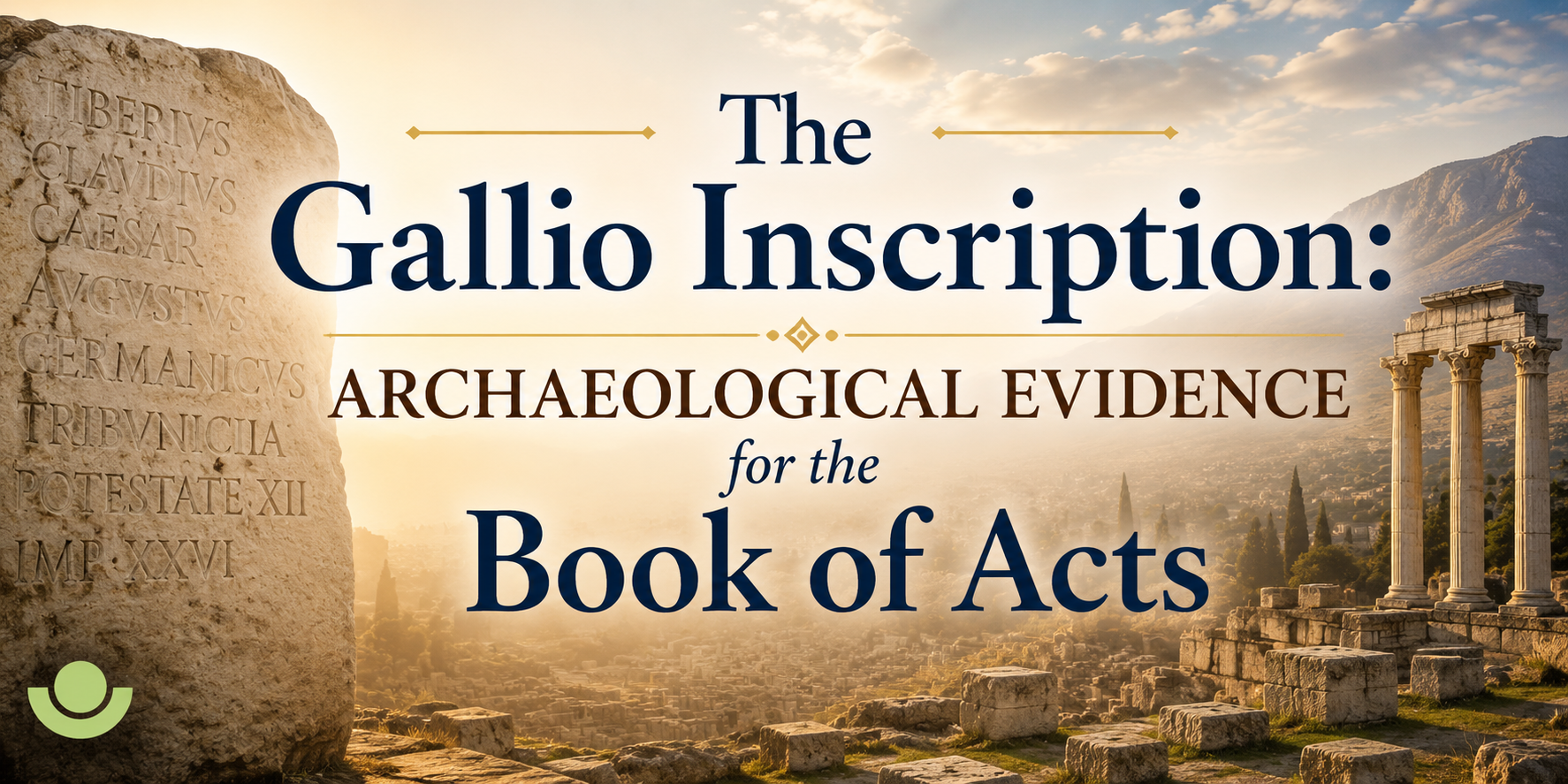
When we read the book of Acts, it can be easy to forget that the people, cities, rulers, and events we encounter belong to real human history. Paul didn’t travel through a fictional world. He walked through actual cities in the Roman Empire, interacted with historical leaders, and wrote letters to real churches facing real challenges.
Every once in a while, archaeology gives us a fascinating glimpse into that world.
One of the most significant archaeological discoveries in the history of early Christianity is the Gallio Inscription. This ancient inscription may not look particularly exciting at first, but it gives historians something incredibly valuable: a specific point in history that helps us trace the movements of the Apostle Paul.
And when we compare it with what Luke records in Acts, some fascinating pieces begin to fall into place.
What Is the Gallio Inscription?
Discovered in 1905 at the temple of Apollo in ancient Delphi, the Gallio Inscription is a copy of a public letter written by Emperor Claudius to his friend, L. Junius Gallio.
In the Dictionary of Paul and His Letters, R. Riesner claims that “chronology is the backbone of history” and suggests that establishing Paul’s timeline is indispensable to the study of early Christianity.
The Gallio Inscription’s remarkable contribution is that it provides a precise moment in history by which to trace the chronology of Paul’s movements.
Dating the Gallio Inscription
The Emperor’s letter begins with:
“Tiberius Claudius Caesar Augustus Germanicus, invested with tribunician power for the 12th time, acclaimed Imperator for the 26th time.”
The inscription indicates that it was written during the twelfth year of Claudius’ reign. This means the letter was composed and sent between January 25 and July 31 in 52 AD.
The significance of the inscription and its date cannot be overstated. With this discovery, historians have an important reference point for dating Paul’s journeys and letters.
The inscription goes on to address the recipient of Claudius’ letter, Gallio:
“For a long time have I been not only well-disposed towards the city of Delphi, but also solicitous for its prosperity, and I have always guarded the cult of the Pythian Apollo. But now since it is said to be destitute of citizens, as L. Junius Gallio, my friend and proconsul,…”
That name and title are particularly important because Gallio also appears in the book of Acts.
Gallio Appears in the Book of Acts
Junius Gallio was proconsul of Achaia, the region that included Corinth.
In Acts 18, Luke records Paul as having stayed in Corinth for eighteen months, “while Gallio was proconsul” (Acts 18:12).
A position as proconsul was a one-year term, but written evidence from Gallio’s brother, Seneca, suggests that Gallio left office in less than a year. The inscription’s address and use of the title proconsul, along with the knowledge that he most likely left Corinth on a ship before the winter season commenced, dates Gallio’s term of service to around the summer of 51.
Paul met Gallio in Corinth when the Jews of the city united against him and dragged him before the proconsul at “the place of judgment,” the bema in the forum of Corinth (Acts 18:12).
This gives historians an important connection between the biblical account and the chronology of the Roman Empire.
How the Inscription Helps Date Paul’s Ministry
With the Gallio Inscription’s date as a starting point, other historical data points more easily fall into place.
When Paul arrived in Corinth, he met Priscilla and Aquila (Acts 18:1-2). They were a Jewish couple who had to leave Rome under Claudius’ expulsion of Jews in 49, the ninth year of his reign, an edict that Nero would overturn sometime in 54/55.
This places Paul’s arrival in Corinth between 49 and 51, early in Gallio’s term of office.
With this well-established date, we can look back at Paul’s second missionary journey and date his time in Philippi and Thessalonica to around 49 or 50 (Acts 16:11-17:9).
In addition, most scholars believe Paul wrote 1 Thessalonians from Corinth, which means that letter dates to around 50/51.
All this places the Jerusalem Council of Acts 15 at an earlier date, around 48.
One inscription gives us a historical anchor, and suddenly several events we read about in the New Testament can be placed more clearly on a timeline.
What Happened After Corinth?
The Gallio Inscription also allows historians to better understand Paul’s timeline following his stay in Corinth.
Moving on from Greece, Paul travels to Jerusalem before returning to Ephesus in 52, from where he writes his first letter to the church in Corinth around 54.
Many scholars believe that Paul was imprisoned in Ephesus and, during this time, wrote letters to Philippi, Colosse, and Philemon. It is possible that the circular letter Ephesians was also written during this time.
While scholars continue to debate some of these dates and locations, the Gallio Inscription provides an important fixed point from which the rest of Paul’s timeline can be considered.
The Final Years of Paul’s Life
The book of Acts leaves Paul’s story unfinished. Readers are unsure whether Paul is released from prison or not.
The early church believed Paul was martyred not at the end of his first imprisonment in Rome but later, in connection with Nero’s persecution of Christians following the fire in Rome in July 64.
This would have allowed enough time for Paul to travel to Spain, “the farthest limits of the West” (1 Clement 5.5-7), after his Roman imprisonment. Paul expressed his desire to travel to Spain in his letter to the Roman church, written during his second visit to Corinth in 57.
There are still questions about exactly what happened during the final years of Paul’s life, but the historical evidence helps us build a reasonable timeline.
Why the Gallio Inscription Matters for Christians Today
Combine the Gallio Inscription with other key historical data points for Paul’s chronology, along with church tradition, and it is possible to trace a logical timeline for Paul’s journeys and letters.
Some questions remain, and not all details emerge clearly, but discoveries like this can increase our confidence in the historical accuracy of the New Testament texts.
The Gallio Inscription is only one piece of evidence, but it is a significant piece for the church. It helps us trace the path of the historic figure Paul the Apostle as he intersected with Roman history and left an indelible mark on the world.
It also reminds us that when we open the book of Acts, we aren’t simply reading stories meant to teach us spiritual truths. We’re reading about the movement of Jesus through real people, in real places, at real moments in history.
Nearly 2,000 years later, archaeology continues to give us fascinating glimpses into that world.
Behind the Scenes: Where is the Gallio Inscription Today?
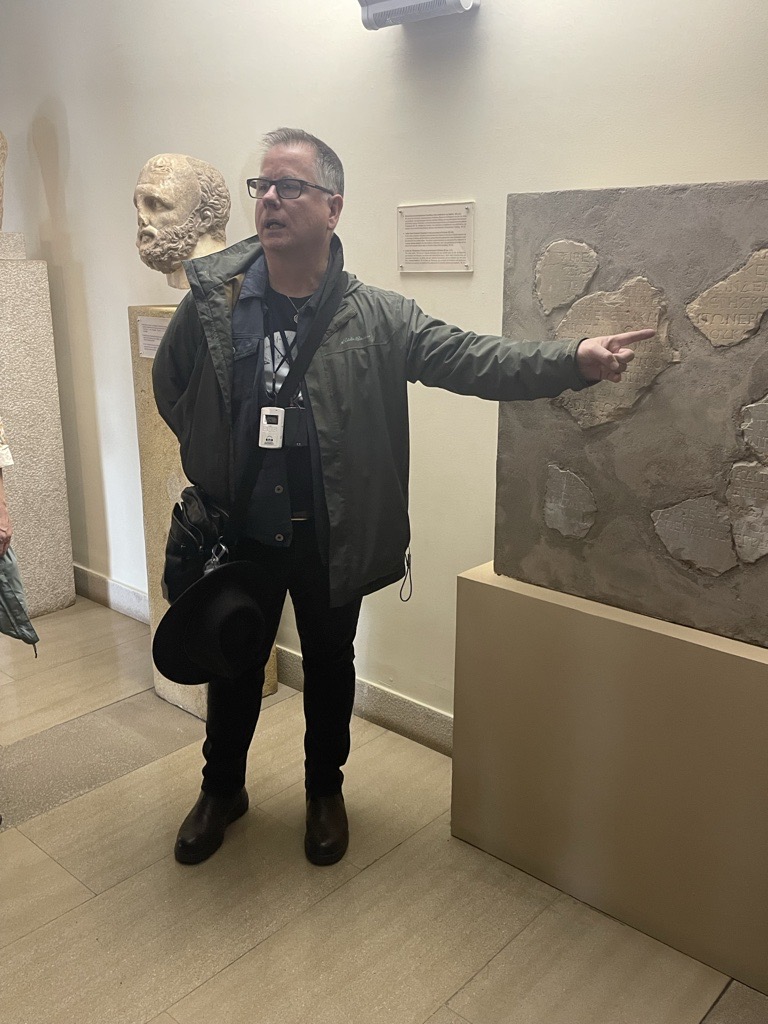
While I was studying in Greece, we visited the Delphi ruins and the museum where the Gallio Inscription sits today as part of the Early Christianity tour of Greece and Rome. Featured in the photo is Dr. John Dickson.
References
McKnight, Scot, ed. Dictionary of Paul and His Letters: A Compendium of Contemporary Biblical Scholarship. Downers Grove, IL: IVP Academic: An Imprint of InterVarsity Press, 2023.
Wright, N. T., and Michael F. Bird. The New Testament in Its World: An Introduction to the History, Literature, and Theology of the First Christians. London; Grand Rapids, MI: Zondervan Academic; SPCK, 2019.
